
Why Your Kitchen Outlets Matter Most When You Host for the Holidays
Holiday hosting asks more of your kitchen wiring than any other stretch of the year, and the outlets along your countertop carry almost all of that extra weight. A normal weeknight might involve a coffee maker and a toaster, but a holiday meal can put a roaster oven, a slow cooker, an air fryer, a stand mixer, and a warming tray on the same run of receptacles at the same time. Every one of those appliances converts electricity into heat, which makes them some of the hungriest loads in the entire house. When too many of them share a single twenty amp circuit, the breaker does exactly what it was designed to do and shuts the power off in the middle of your prep. Guests are usually arriving right about then, the oven timer is going, and nobody wants to be hunting for a flashlight in the garage. Understanding how your kitchen outlets are wired, what they can safely carry, and what the early warning signs of trouble look like will save your holiday meal long before the first car pulls into the driveway.
What Holiday Hosting Demands From Your Kitchen Outlets
The kitchen is the only room in a home that the National Electrical Code singles out for multiple dedicated appliance circuits, and there is a very good reason for that. Small countertop appliances draw far more current than lamps, televisions, or phone chargers, and they tend to run all at once during a big cooking day. Code requires at least two twenty amp small appliance branch circuits to serve the countertop receptacles in a kitchen, and it requires that countertop outlets be protected by GFCI devices because of the constant presence of water. Those rules set a floor, not a ceiling, and a kitchen built to the bare minimum in 1994 was never designed around today’s appliance habits. Holiday cooking exposes that gap quickly. A little planning around your existing outlets, combined with a few targeted upgrades, keeps the meal on schedule.
The Kitchen Outlets That Carry Your Countertop Appliance Load
A standard twenty amp kitchen circuit running at 120 volts can deliver 2,400 watts on paper, but the practical working limit for anything running longer than three hours sits closer to 1,920 watts because continuous loads are calculated at eighty percent of the breaker rating. That number disappears faster than most homeowners expect once holiday appliances come out of the pantry. A countertop roaster oven pulls somewhere between 1,400 and 1,500 watts by itself, which means it can occupy most of a circuit on its own without any help. An air fryer lands in the same neighborhood, a drip coffee maker can hit 1,200 watts while brewing, and an electric griddle regularly draws 1,500 watts. Add a 1,100 watt microwave to any two of those and the breaker has every reason to open. The math is not a flaw in your home; it is the protective system working correctly to keep the wire inside your wall from overheating.
The trouble is that homeowners rarely know which kitchen outlets share a circuit, so they spread appliances across the counter and assume the load is spread out too. Two receptacles four feet apart can easily be fed by the same cable, while two receptacles on opposite ends of the same wall might be on completely different breakers. Builders route circuits for efficiency during construction, not for the way a family cooks twenty years later. That is why one side of a kitchen can go dark while the rest of the room keeps humming along. Mapping your circuits ahead of the holiday takes about twenty minutes with a helper and a lamp, and the information is worth having permanently. Label the panel directory once and you will use it for years.
Older homes deserve extra attention here, because kitchens wired before the mid 1950s often have no dedicated small appliance circuits at all. In those houses, the countertop outlets may share a fifteen amp general lighting circuit with the dining room, the hallway, and part of the living room. A single roaster oven can consume that entire circuit before anyone has plugged in a mixer. Homes built in the 1970s and 1980s frequently have the two required circuits but no separate feed for the refrigerator, which creates a different problem when a tripped breaker quietly warms up your turkey and your dairy at the same time. Adding capacity is the real fix in these cases rather than rearranging cords. If your kitchen keeps running out of power on ordinary days, a dedicated circuit installation gives your heaviest appliances a supply line of their own.
How Kitchen Outlets Are Wired on Small Appliance Circuits
The two required small appliance branch circuits in a kitchen are meant to serve the countertop receptacles, the refrigerator space, and the receptacles in the dining area, and code prohibits those circuits from feeding general lighting elsewhere in the house. That separation exists so a lamp in the den never competes with a toaster oven for the same twenty amps. Many builders split the countertop receptacles so alternating outlets land on different circuits, which is a smart practice that gives you natural places to spread the load. Other builders wire one wall to one circuit and the opposite wall to the second, which is code compliant but far less forgiving on a busy cooking day. There is no way to tell which approach was used by looking at the faceplates. Testing is the only reliable method, and the results usually surprise people.
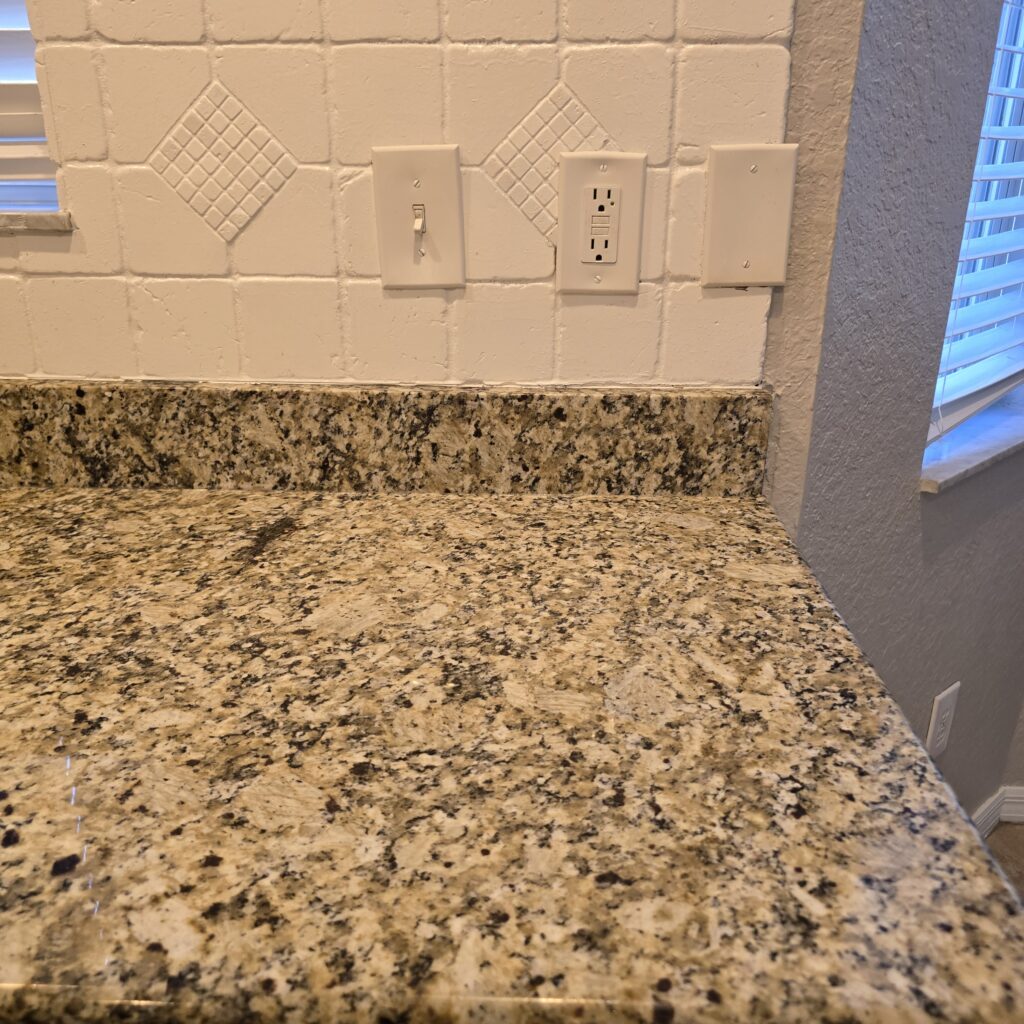
Kitchen receptacle spacing is governed by a rule most homeowners have never heard of but benefit from constantly. Code requires that no point along a countertop wall line be more than twenty four inches from a receptacle, which effectively means an outlet every four feet along usable counter space. Any counter section wider than twelve inches needs a receptacle of its own, and modern code editions also address islands and peninsulas with their own requirements. Kitchens remodeled without permits often violate these spacing rules, leaving long stretches of granite with nowhere to plug in. The workaround people reach for is an extension cord or a power strip stretched across the counter, which is exactly the arrangement that causes overloads and trip hazards during a party. Adding properly placed receptacles removes the temptation entirely.
Protection requirements have expanded steadily over the past several code cycles, and that history explains a lot about what you find behind your faceplates. GFCI protection has been required for kitchen countertop receptacles since the late 1980s, and recent code editions extended GFCI requirements to dishwashers and other kitchen appliance outlets. Arc fault protection was added for kitchen circuits in the 2014 code, and tamper resistant receptacles became standard for dwelling units around the same era. Texas jurisdictions adopt these editions on their own schedules, so a home in Burleson and a home in Mansfield can legally have different protection levels depending on the permit date. None of this makes an older kitchen unsafe by definition, though it does mean the safety margin varies from house to house. An electrician can tell you within a few minutes which generation of rules your kitchen was built under.
Warning Signs Your Kitchen Outlets Cannot Handle Holiday Cooking
Repeated breaker trips are the most obvious signal, and they should be treated as information rather than an inconvenience. A breaker that opens once when you plug a fourth appliance into a crowded circuit is behaving normally and telling you the load is too high. A breaker that trips with only two modest appliances running points toward something else, such as a loose connection, a damaged conductor, or a breaker that has weakened after years of thermal cycling. Nuisance tripping also happens when a GFCI device ages past its useful life, since the internal sensing components do wear out. The distinction matters because one problem is solved by unplugging something and the other requires repair. Guessing wrong leaves a real fault energized inside your wall through the busiest cooking day of the year.
Physical symptoms at the receptacle itself deserve immediate attention and should never wait until after the holidays. A faceplate that feels warm to the touch, a plug that falls loose from the slots, discoloration or scorch marks around the openings, and a faint buzzing sound all point toward a connection that is arcing or a receptacle whose internal contacts have lost tension. Heat at a receptacle is not normal under any circumstance, and it is one of the leading contributors to residential electrical fires. Loose backstab connections on the rear of older receptacles are a common culprit, as are aluminum branch circuit conductors in homes built between roughly 1965 and 1974. Any burning smell near an outlet calls for the circuit to be shut off at the panel right away. Stop using that receptacle and have it evaluated before you cook anything.
Lights that dim when the refrigerator compressor starts, outlets that work intermittently, and receptacles that only function when the plug is held at a certain angle all indicate deteriorating connections somewhere in the circuit. These symptoms rarely improve on their own; they progress, and heavy holiday loading accelerates the process considerably. A half hot outlet that suddenly stops working on one side often means a broken conductor or a failed device rather than a switch problem. Two prong receptacles are another flag, since they indicate a circuit with no equipment grounding conductor, which is a serious concern in a room full of water and metal appliances. Ungrounded kitchen outlets can be brought up to a safer standard with GFCI protection and proper labeling, and rewiring is the more complete solution when the walls allow. Catching these issues in the fall gives you time to fix them properly rather than scrambling in December.
How to Prepare Your Kitchen Outlets Before Guests Arrive
Preparing your kitchen outlets is straightforward work that pays off immediately, and most of it can be done in a single afternoon. The goal is to confirm that every protective device functions, to learn which receptacles share circuits so you can distribute appliances intelligently, and to replace anything that shows physical wear. None of this requires you to change how you cook; it simply removes the failure points that turn a good meal into a stressful one. Homeowners who do this once tend to repeat it every year because the payoff is so obvious. Start early enough that a needed repair can be scheduled without rushing. A kitchen that handles Thanksgiving without a single trip will handle Christmas the same way.
Testing Your GFCI Kitchen Outlets Before the Holidays
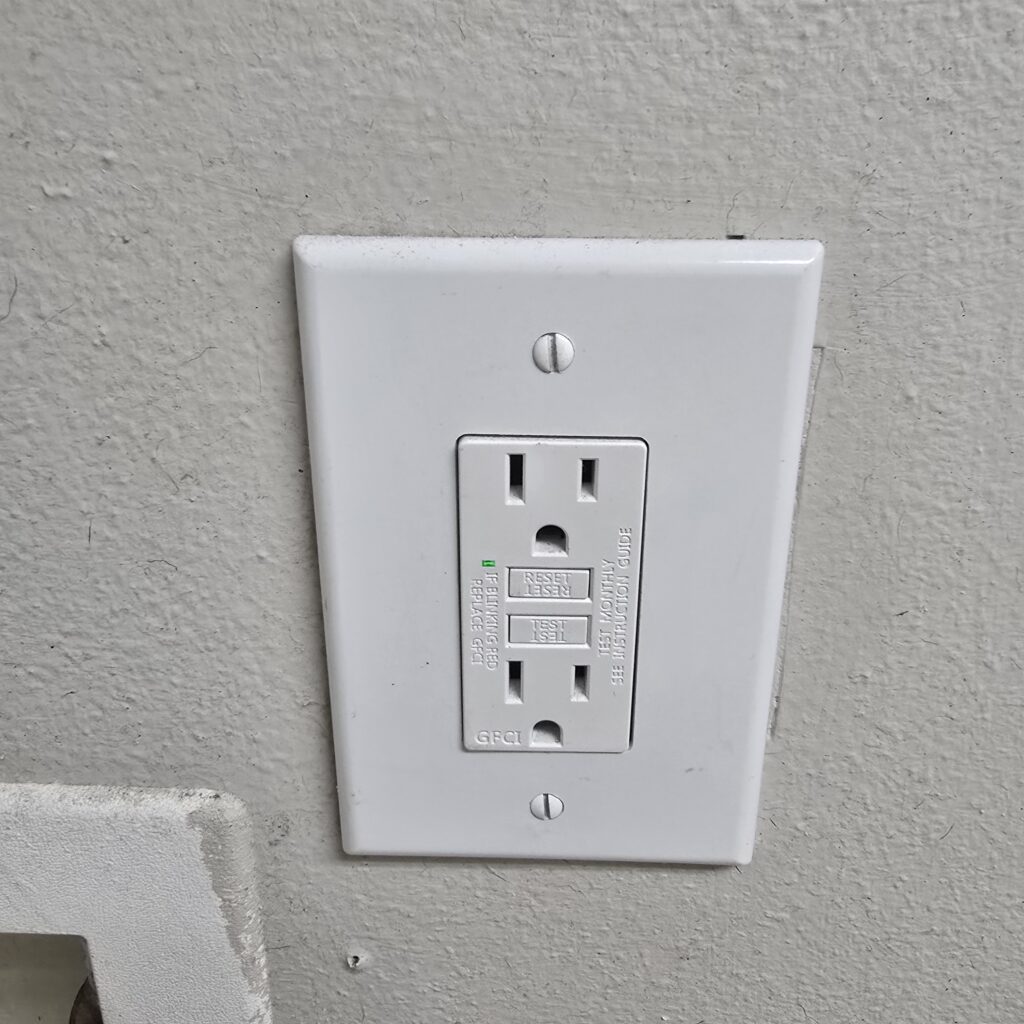
Ground fault circuit interrupters protect people, not equipment, and they do it by comparing the current leaving on the hot conductor with the current returning on the neutral. When those values differ by roughly four to six milliamperes, the device opens the circuit in a fraction of a second because that missing current is traveling through some unintended path, potentially a person. In a kitchen full of water, metal sinks, and wet hands, this protection is genuinely lifesaving. Testing is simple: press the button marked TEST, confirm that power to the receptacle stops, then press RESET and confirm power returns. Manufacturers recommend testing monthly, and the weeks before a big hosting season are a natural reminder. A device that does not trip when tested, or one that will not reset, has failed and needs replacement.
Many kitchen outlets are protected downstream from a single GFCI device rather than having their own, which means one dead receptacle can take several others with it. The upstream device is often located under the sink, behind the refrigerator, in the garage, or even in a bathroom on the other side of the wall. This is why a homeowner will sometimes find three countertop outlets dead with no tripped breaker in the panel. Knowing where your GFCI devices live turns a mysterious outage into a ten second fix. Write the locations on the inside of a cabinet door where anyone in the family can find them. That small note has rescued more than a few holiday dinners.
Newer GFCI devices include self testing circuitry that monitors internal components and indicates failure through a light or an audible signal, which is a meaningful improvement over older units that could quietly stop protecting years before anyone noticed. Standard receptacles typically last decades, though GFCI devices carry a shorter service life because of the electronics inside them, and surge activity or heavy use shortens it further. Replacing a fifteen year old GFCI is inexpensive insurance in a room where water is always present. Reversed line and load connections are a common installation error that leaves downstream outlets unprotected while the device still appears to work normally. Correct wiring cannot be verified from the outside, which is one reason professional testing catches problems homeowner inspections miss. If your kitchen protection needs updating, our GFCI outlet installation service brings those receptacles up to current safety standards.
Spreading Appliance Load Across Kitchen Outlets on Different Circuits
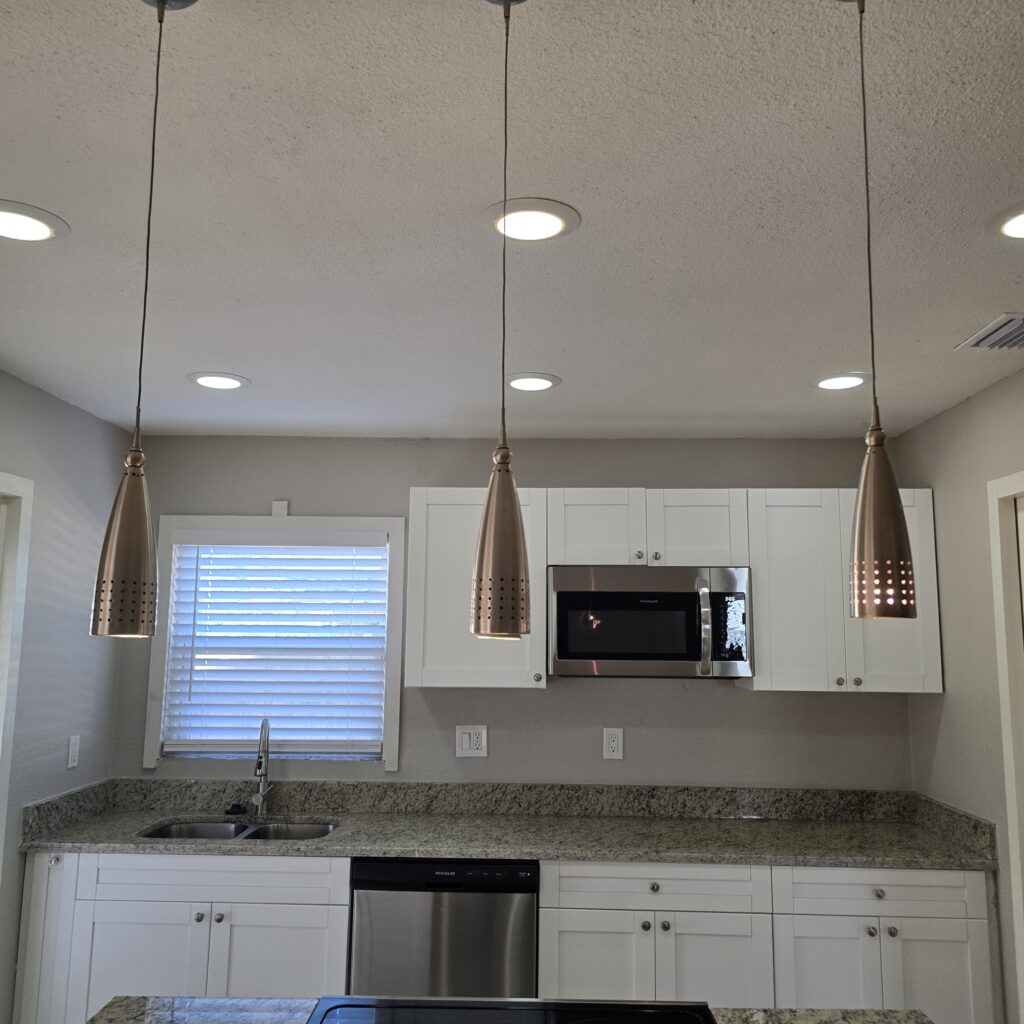
Once you know which outlets share a circuit, load planning becomes a simple exercise in arithmetic. Keep the highest wattage appliances on separate circuits, and treat anything at or above 1,200 watts as a device that essentially owns whatever circuit it is plugged into. A roaster oven and an air fryer running together on one twenty amp circuit will exceed the safe continuous load almost immediately, while the same two appliances on separate circuits run comfortably all day. Small items like a stand mixer, a blender, or a hand mixer draw far less and run in short bursts, so they can share space with a larger appliance without much risk. The rule of thumb that serves most families well is one heat producing appliance per circuit. Everything else can fill in around it.
Location choices help more than people expect. The dining room receptacles are usually fed by one of the small appliance circuits, which makes them an excellent home for a slow cooker or a warming tray that would otherwise crowd the kitchen counter. A nearby laundry room or garage receptacle can host an extra appliance during the meal, provided you use a heavy gauge cord rated for the load and route it where nobody will trip. Bathroom receptacles are a poor choice because they are on their own circuit for a reason and often share with other bathrooms. Avoid running kitchen appliances through general purpose living room outlets, since those fifteen amp circuits usually feed multiple rooms. Thinking about the whole floor plan rather than just the kitchen gives you far more capacity than you realized you had.
Power strips deserve a specific warning during holiday cooking. A relocatable power tap is designed for low draw electronics, and plugging two heat producing appliances into one creates a serious fire risk regardless of what the packaging claims. The same applies to lightweight extension cords, which overheat under sustained high current and are involved in a significant share of holiday season electrical fires. If you consistently need more receptacles than your kitchen provides, the honest answer is that the kitchen needs more circuits rather than more adapters. Adding a twenty amp circuit with two or three new receptacles is a manageable project that permanently solves the problem. Homeowners who make that investment almost always say they should have done it years earlier.
When Damaged Kitchen Outlets Need Replacement Before the Holidays
Receptacles are mechanical devices with metal contacts that lose spring tension over thousands of insertion cycles, and kitchen outlets see more plugging and unplugging than any others in the house. A worn receptacle grips the plug loosely, which reduces contact area, increases resistance, and generates heat at exactly the point where you cannot see it. That heat degrades the plastic housing and the conductor insulation over time, creating conditions that lead to arcing. The simple test is to plug something in and see if it stays put; a plug that sags or falls out has told you what you need to know. Replacement is inexpensive and takes only a few minutes for a qualified electrician. Waiting until the device fails during a holiday meal is the expensive version of the same repair.
Backstab connections are worth understanding because they explain a large percentage of intermittent outlet failures in homes built from the 1970s onward. These push in terminals on the back of a receptacle rely on a small spring clip to hold the conductor, and that clip loosens as the connection heats and cools through years of use. A properly made connection wraps the conductor around the terminal screw or uses the pressure plate designed for that purpose, which provides dramatically more contact area and mechanical security. When an electrician replaces a kitchen receptacle, moving the conductors to screw terminals is standard practice and part of why the repair lasts. It is a small detail with an outsized effect on reliability. Homeowners rarely know to ask for it, and good electricians do it without being asked.
Certain conditions call for an electrician rather than a hardware store trip, and recognizing them protects your home. Aluminum branch circuit wiring requires devices rated CO/ALR or approved connectors, because standard receptacles installed on aluminum conductors are a known fire hazard. Ungrounded two wire circuits have specific code allowed remedies that must be labeled correctly. Overcrowded boxes, damaged conductor insulation, evidence of previous overheating, and unpermitted remodel work all point toward problems larger than the visible device. Scorch marks inside a box mean an event already occurred there and the circuit needs evaluation before it is put back in service. Should you notice tripping breakers along with any of these signs, our circuit breaker repair service addresses the panel side of the problem at the same time.
Why You Need a Kitchen Outlet Inspection Before You Host
An inspection before the hosting season replaces guesswork with a clear picture of what your kitchen can actually support. An electrician can map every circuit, measure the load on each one, verify GFCI and arc fault protection, check connections for heat damage, and identify the specific upgrades that would eliminate your recurring problems. That visit typically takes an hour or two and gives you information you will use for as long as you own the home. The cost of the inspection is small next to the cost of a ruined meal, a damaged appliance, or a fire. Scheduling it in early fall means any recommended work can be completed well before the first gathering. Homeowners consistently tell us the peace of mind was the best part.
The Value of a Professional Kitchen Outlet Inspection
A professional inspection catches conditions that are invisible from the outside of a faceplate, which is where most kitchen wiring problems actually live. Electricians pull devices, examine terminations, look for heat discoloration on conductors, check box fill, and confirm that grounding is present and continuous. They also verify that GFCI devices are wired with line and load in the correct positions, a mistake that leaves downstream receptacles unprotected while everything appears normal. Load measurements taken with a clamp meter show exactly how close each circuit runs to its limit under real conditions. That data turns vague frustration into a specific plan.
Inspections also reveal work performed by previous owners or unlicensed handymen, which is remarkably common in kitchens because remodeling is so frequent. Spliced connections buried in walls without a box, circuits extended beyond their intended capacity, missing GFCI protection after a countertop replacement, and receptacles fed from the wrong circuit all show up regularly. None of these are visible during a home purchase walkthrough, and standard home inspections only sample a few outlets. Finding them before they cause a failure gives you the option of a planned repair rather than an emergency one. Documentation from the inspection is also useful for insurance and resale purposes.
Timing matters more than most people consider. Electrical contractors across North Texas are busiest during extreme weather and around the holidays, so a small repair scheduled in September gets attention quickly while the same repair in late November competes with emergency calls. Parts availability is better, appointment windows are wider, and you are not making decisions under pressure. An inspection in the fall also lines up naturally with checking smoke detectors and surge protection before the heaviest use season. Making it an annual habit takes very little effort. The households that do it rarely have holiday surprises.
Upgrades That Solve Kitchen Outlet Problems for Good
Adding dedicated circuits is the most effective permanent fix for a kitchen that runs out of capacity, and it is far less disruptive than homeowners assume. A new twenty amp circuit from the panel to the kitchen gives your roaster, air fryer, or coffee station a supply that nothing else touches. Refrigerators benefit enormously from their own circuit, since a nuisance trip that goes unnoticed overnight can cost you hundreds of dollars in spoiled food. Microwaves, dishwashers, and disposals are all commonly placed on dedicated circuits in modern construction for the same reason. The work is usually completed in a day.
Panel capacity sometimes becomes the limiting factor, particularly in homes with older service equipment or a panel that is already full. A service upgrade or a subpanel addition creates room for the new circuits your kitchen needs while also supporting future additions like an EV charger or a hot tub. Some older panel brands have known reliability concerns and are worth replacing on safety grounds regardless of capacity. An electrician can tell you quickly which situation applies to your home. Financing options make larger projects manageable when they are needed.
Protection upgrades round out the picture and cost very little relative to their benefit. Replacing aging GFCI devices, adding arc fault protection where the panel allows, and installing whole house surge protection guard both your family and your appliances. Modern kitchen appliances contain sensitive electronics that surges damage easily, and a single event can take out a refrigerator control board, a microwave, and a dishwasher at once. Combining these upgrades with new circuit work during one visit saves labor cost. Getting it all done at once means you stop thinking about it.
Why Choose Wallace Electric for Your Kitchen Outlet Work
Wallace Electric is a family owned and operated electrical company serving Burleson, Fort Worth, Mansfield, Crowley, Cleburne, Joshua, Arlington, and the surrounding communities. Every technician who comes to your home is background checked and drug tested, because we understand that inviting a contractor into your kitchen requires real trust. We provide professional white glove service on every call, which means drop cloths, shoe covers, and a workspace left cleaner than we found it. Our installations are safe and code compliant, and we pull permits where they are required rather than cutting corners. Doing the work correctly is not a premium option here; it is the only way we work.
We offer a five year parts and labor warranty on qualifying work, and financing options are available for larger electrical projects so a needed upgrade does not have to wait. Our emergency electrician service runs around the clock, which matters a great deal when a kitchen circuit fails the night before a family gathering. We show up when we say we will, explain what we found in plain language, and give you clear pricing before any work begins. You will never get a vague answer or a scare tactic from our team. Straight information and honest recommendations are what we build our reputation on.
Holiday hosting should be about the people around your table, not about which breaker is going to trip next. Let us map your kitchen circuits, test your protection devices, and add the capacity your cooking actually requires so the meal runs the way you planned it. Call Wallace Electric at (817) 476-7753 to schedule your kitchen outlet inspection or to talk through upgrade options for your home. If you would rather start online, our electrical inspection service page explains exactly what we check and how the visit works. We look forward to keeping your kitchen powered through every holiday you host.